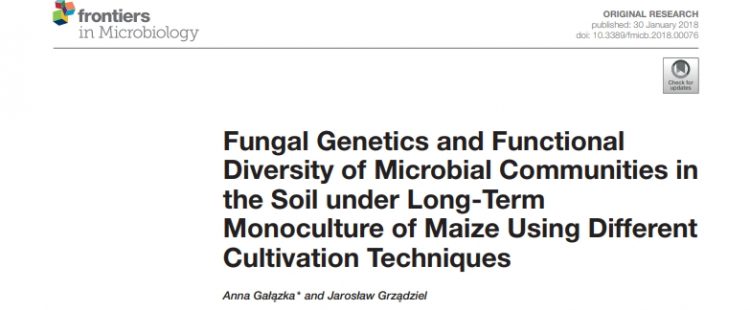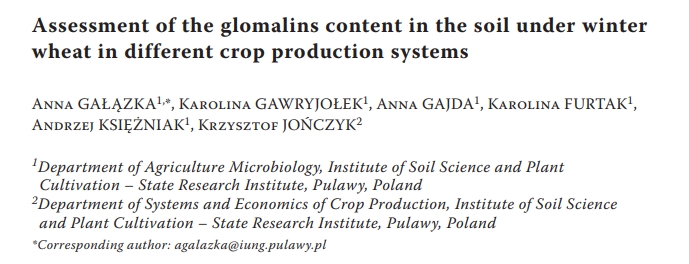
Nowa publikacja pracowników w International Agrophysics

Nowa publikacja pracowników w International Agrophysics

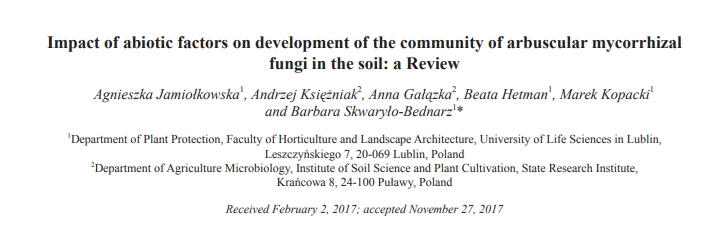
Impact of abiotic factors on development of the community of arbuscular mycorrhizal fungi in the soil: a Review; Jamiołkowska A., Księżniak A., Gałązka A., Hetman B., Kopacki M., Skwaryło- Bednarz B.; International Agrophysics, 2018, 32, 1, 133-140,10.1515/intag-2016-0090

Link do publikacji: http://www.international-agrophysics.org/en/artykul/1084


Abstract:

Arbuscular mycorrhizal fungi inhabiting soil play an important role for vascular plants. Interaction between arbuscular mycorrhizal fungi, plants and soil microorganisms leads to many mutual advantages. However, the effectiveness of mycorrhizal fungi depends not only on biotic, but also abiotic factors such as physico-chemical properties of the soil, availability of water and biogenic elements, agricultural practices, and climatic conditions. First of all, it is important to adapt the arbuscular mycorrhizal fungi species to changing environmental conditions. The compactness of the soil and its structure have a huge impact on its biological activity. Soil pH reaction has a substantial impact on the mobility of ions in soil dilutions and their uptake by plants and soil microflora. Water excess can be a factor negatively affecting arbuscular mycorrhizal fungi because these microorganisms are sensitive to a lower availability of oxygen. Mechanical cultivation of the soil has a marginal impact on the arbuscular mycorrhizal fungi spores. However, soil translocation can cause changes to the population of the arbuscular mycorrhizal fungi abundance in the soil profile. The geographical location and topographic differentiation of cultivated soils, as well as the variability of climatic factors affect the population of the arbuscular mycorrhizal fungi in the soils and their symbiotic activity.

Nowa publikacja pracowników w International Agrophysics

Nowa publikacja pracowników w International Agrophysics

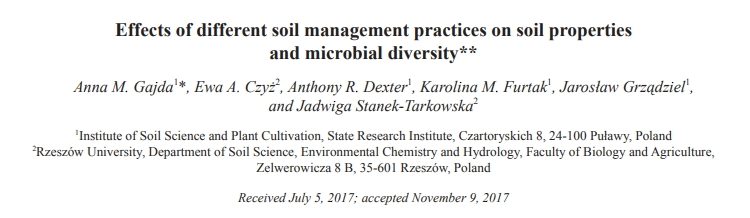
Effects of conventional and reduced tillage of soil wellness. Gajda A.M., Czyż E.A, Dexter A.R, Furtak K.M., Grządziel J., Stanek-Tarkowska J.; International Agrophysics, 2018, 32, 81-91, doi: 10.1515/intag-2016-0089;

Link do publikacji: http://www.international-agrophysics.org/en/artykul/1079


Abstrakt

The effects of different tillage systems on the properties and microbial diversity of an agricultural soil was investigated. In doing so, soil physical, chemical and biological properties were analysed in 2013-2015, on a long-term field experiment on a loamy sand at the IUNG-PIB Experimental Station in Grabów, Poland. Winter wheat was grown under two tillage treatments: conventional tillage using a mouldboard plough and traditional soil tillage equipment, and reduced tillage based on soil crushing-loosening equipment and a rigid-tine cultivator. Chopped wheat straw was used as a mulch on both treatments. Reduced tillage resulted in increased water content throughout the whole soil profile, in comparison with conventional tillage. Under reduced tillage, the content of readily dispersible clay was also reduced, and, therefore, soil stability was increased in the toplayers, compared with conventional tillage. In addition, the beneficial effects of reduced tillage were reflected in higher soil microbial activity as measured with dehydrogenases and hydrolysis of fluorescein diacetate, compared with conventional tillage. Moreover, the polimerase chain reaction – denaturing gradient gel electrophoresis analysis showed that soil under reduced tillage had greater diversity of microbial communities, compared with conventionally-tilled soil. Finally, reduced tillage increased organic matter content, stability in water and microbial diversity in the top layer of the soil.

Zakład Mikrobiologii
IUNG-PIB w Puławach

X

Kontynuując korzystanie z witryny, wyrażasz zgodę na używanie plików cookie. więcej informacji

The cookie settings on this website are set to "allow cookies" to give you the best browsing experience possible. If you continue to use this website without changing your cookie settings or you click "Accept" below then you are consenting to this.

Close